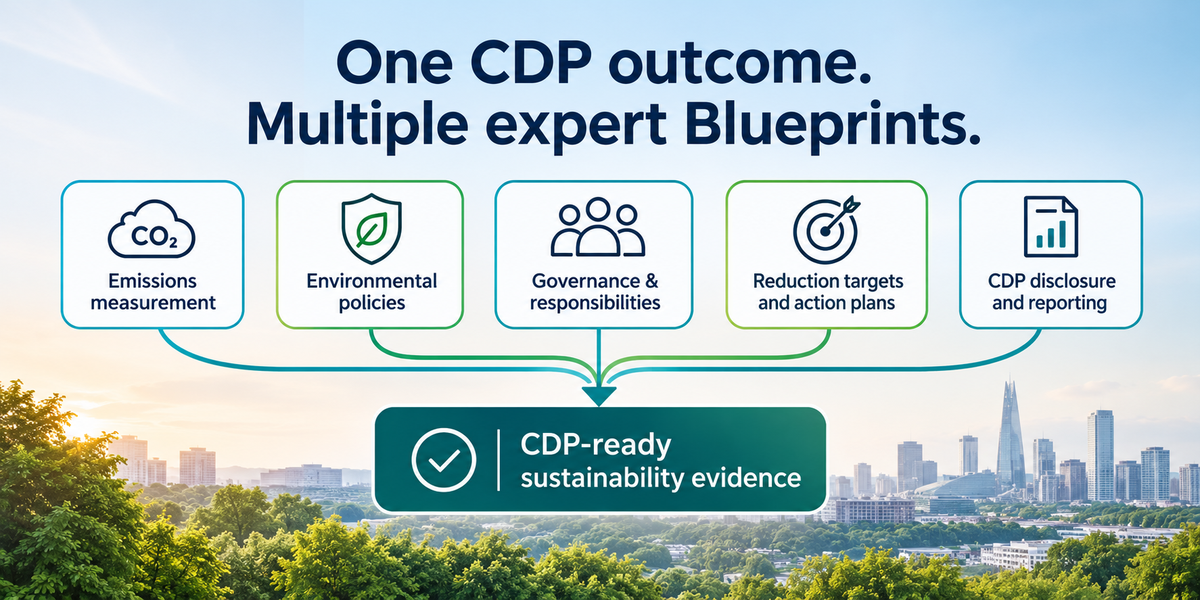
For many organisations, completing a CDP disclosure can feel like a significant exercise in gathering information, coordinating internal teams and translating existing sustainability activities into a structured response.
But a successful disclosure is about much more than answering questions. It requires an organisation to demonstrate that it understands its environmental impact, has appropriate policies and governance in place, can measure its emissions, and has a credible approach to managing and reducing them.
This is where a joined-up approach to emissions and policy Blueprints can make a real difference.
At Qonstrue, we believe that achieving a complex sustainability outcome shouldn't depend on one person having to know everything. Instead, specialist expertise can be brought together through a collection of expert-authored Blueprints, each addressing a particular requirement and contributing towards a shared objective.
1. Building the foundations: Emissions data that supports disclosure
An organisation cannot effectively manage or report its environmental impact without understanding where its emissions come from.
Emissions Blueprints help businesses establish a structured, evidence-based approach to measuring and managing their carbon footprint.
This can include:
- Scope 1 emissions: Identifying and calculating direct emissions from fuel consumption, company vehicles, gas, refrigerants and other owned or controlled sources.
- Scope 2 emissions: Establishing electricity consumption and associated location-based and market-based emissions.
- Scope 3 emissions: Identifying relevant value-chain emissions, including purchased goods and services, business travel, employee commuting, transportation, waste and other indirect activities.
- Emissions methodology: Applying recognised calculation methodologies and appropriate emissions factors, with transparency around assumptions and data quality.
- Data validation: Identifying gaps, improving the quality of source information and establishing a reliable audit trail.
These foundations provide much of the quantitative evidence needed to support CDP's climate change disclosure requirements.
However, calculating emissions is only one part of the picture.
Businesses must also explain how they use this information to inform decisions, manage risks and drive improvements.
2. Connecting emissions performance with environmental policies
CDP looks beyond an organisation's carbon footprint. It also considers the policies, responsibilities, governance structures and management processes that underpin its environmental commitments.
This is where policy Blueprints become particularly valuable.
Rather than approaching each policy as an isolated document, organisations can use a collection of specialist policy Blueprints to establish a coherent environmental management framework.
For example:
Environmental Policy
Sets out the organisation's overall environmental commitments, responsibilities and approach to managing its environmental impact.
Climate Change Policy
Defines how the business approaches climate-related risks, emissions reduction, energy management and its transition towards a lower-carbon operation.
Energy Management Policy
Establishes responsibilities and processes for monitoring energy consumption, improving efficiency and reducing associated emissions.
Sustainable Procurement Policy
Demonstrates how environmental considerations are incorporated into purchasing decisions and supplier engagement, helping address Scope 3 emissions.
Waste Management Policy
Sets out how waste is managed, monitored and reduced, including opportunities for reuse, recycling and improved resource efficiency.
Business Travel Policy
Establishes expectations around travel decisions, lower-carbon alternatives and the monitoring of associated emissions.
Each policy addresses a different area of environmental management, but together they help demonstrate that sustainability is embedded in the organisation's operations rather than being limited to an annual carbon calculation.
Importantly, policies should reflect what the organisation actually does, with clear ownership, implementation and supporting evidence. Having a policy document alone does not demonstrate that a commitment is being delivered.
3. Bringing everything together to support CDP
The real value comes when emissions data, policies and operational processes work together.
Consider how a business might approach its CDP disclosure using a series of specialist Blueprints.
Business requirementRelevant Blueprint contributionEstablish an emissions baselineEmissions data collection and calculationImprove Scope 1 and 2 reportingFuel and electricity emissions assessmentUnderstand Scope 3 emissionsSupplier and value-chain emissions assessmentDemonstrate environmental commitmentsEnvironmental and climate policy developmentEvidence responsible purchasingSustainable procurement policyEstablish reduction commitmentsCarbon reduction planning and target-settingDemonstrate progressEmissions monitoring and reporting
These activities support different elements of the CDP questionnaire, including environmental policies, governance, emissions reporting, targets, business strategy and emissions reduction initiatives.
The benefit is that the organisation isn't starting from scratch every time it faces a new reporting requirement.
Instead, it is developing a connected body of information, documentation and evidence that can be reused and updated as the business progresses.
4. One outcome. Multiple Blueprints. Specialist expertise.
This is the thinking behind Qonstrue Blueprints.
A Blueprint is an expert-developed service or workflow designed to address a specific business requirement. It captures specialist knowledge and turns it into something that can be applied consistently to real business challenges.
For example, supporting a business towards a CDP submission might involve several different experts:
- A carbon accounting specialist develops the emissions baseline and calculation methodology.
- An environmental consultant establishes the environmental management framework.
- A sustainability policy expert develops the necessary policies and supporting documentation.
- A supply chain specialist helps address supplier engagement and Scope 3 emissions.
- A climate strategy specialist develops reduction scenarios and supports target-setting.
Each expert contributes a different capability, but the organisation is working towards one shared outcome: a stronger, more complete and better-evidenced environmental disclosure.
Rather than expecting one consultant or internal sustainability manager to possess every specialism, businesses can access the expertise they need, when they need it.
The Blueprints can also be used independently. An organisation that already has a carbon footprint might only need support with its policies, while another may need to establish its emissions baseline before progressing to reduction planning.
This modular approach means businesses can build on what they already have, address gaps and develop their sustainability capability over time.
5. Beyond CDP: Creating value that continues
Perhaps the biggest benefit is that the work doesn't end when the CDP questionnaire is submitted.
The emissions baseline can inform annual reporting and reduction targets. Environmental policies can support internal governance, customer requirements and supplier assessments. Procurement processes can help improve Scope 3 data and engagement. Reduction plans can translate commitments into measurable operational improvements.
The same underlying work can also support other frameworks and requirements, including SBTi, ISO 14001, customer sustainability questionnaires and wider ESG reporting.
Rather than repeatedly producing documents for individual reporting exercises, businesses can develop a more consistent and reusable sustainability management approach.
CDP becomes one outcome of a broader programme of improvement, rather than a standalone annual task.
6. An opportunity for experts to contribute
For sustainability professionals, consultants and technical specialists, this approach creates an opportunity to put practical expertise to work in a different way.
Qonstrue's Blueprint community brings together people with different areas of knowledge and experience. Experts can develop Blueprints around the services, methodologies and specialist processes they already understand and use in their work.
A Blueprint doesn't need to cover an entire sustainability programme. In fact, its value can come from doing one particular thing exceptionally well.
One expert might develop a robust Scope 3 assessment process. Another might specialise in environmental policies. Another might focus on emissions reduction scenarios or SBTi target-setting.
Together, these contributions can support a much bigger business objective.
The opportunity is to turn individual expertise into practical, accessible services that can be combined to solve real business challenges.
Bringing expertise together
At Qonstrue, we see the future of sustainability support as collaborative rather than fragmented.
Businesses need access to the right expertise, reliable processes and practical support to turn their environmental commitments into measurable action.
By bringing together expert-authored Emissions and Policy Blueprints, we can help organisations move from understanding their impact to demonstrating how they manage it, reduce it and report on progress.
One business objective. Multiple specialist Blueprints. One connected outcome.